articles / Culture
Peach Melba and Melba Toast: The Story of a Chef and an Opera Diva

Auguste Escoffier, a leading French chef who popularized haute cuisine and served as executive chef at grand hotels including the Savoy, the Ritz, and the Carlton.
Born in 1846 in a small town outside of Nice, Auguste Escoffier became one of the leading chefs of the new methods of haute cuisine. In 1884, Escoffier began work at the new Grand Hotel in Monte Carlo, a popular winter resort hotel managed by César Ritz. Together, Ritz and Escoffier left for London in 1890 to take an offer at the Savoy, where they were successful in attracting a wealthy and star-studded client base. Escoffier worked as the executive chef at the Savoy for nine years, later moving to the Ritz in Paris and the Carlton in London.
Escoffier revolutionized the food industry by instituting new standards for restaurant kitchens and developing a new marketing ploy—dishes named for celebrities. At a time when kitchens were noisy and drinking on the job was common, Escoffier expected nothing less than orderly silence and diligence from his chefs. A savvy marketer, he transformed not only how kitchens were run but also haute cuisine itself, publishing his recipes and creating catchy names for his dishes as an homage to the famous patrons of his restaurants.

Peach Melba, named for Australian coloratura soprano Nellie Melba.
At the Savoy, Escoffier invented Peach Melba in 1893 in honor of Australian opera singer Nellie Melba, a fixture on the London scene who stayed at the Savoy while performing at Covent Garden. For this signature dish, fresh peaches combine with raspberry puree and vanilla ice cream to produce a simple and elegant dessert. Get the recipe here.

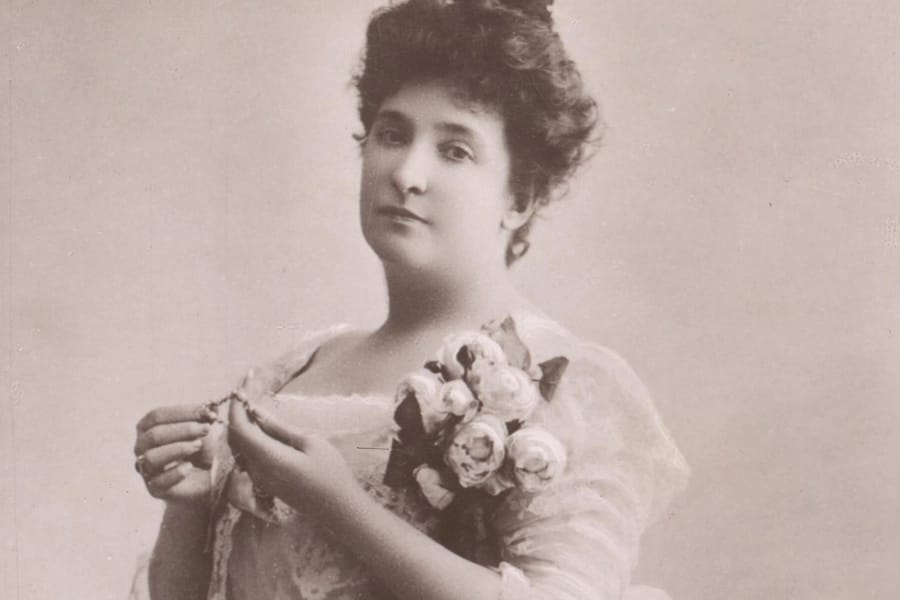
Nellie Melba, an Australian star who was one of the most famous opera singers of the 1890s and early 1900s.
Born in 1861 in Burnley, a small town outside of Melbourne, Nellie Melba changed her name from Helen Porter Mitchell in 1887 when she began performing abroad, taking the name Madame Melba as a nod to her Melbourne roots. Besides frequent engagements in London, Melba also performed across Europe and the United States. Some of her notable roles included Violetta in Verdi’s La Traviata and the title role in Donizetti’s Lucia di Lammermoor.
When she fell ill during an 1897 stay at the Savoy, Escoffier made her another famous dish he also named for her: Melba toast. The opera diva allegedly complained that her toast was too thick, requesting an extremely thin toast. Escoffier knew that bread sliced too thin would burn before it was properly toasted, so he came up with the ingenious solution of slicing the bread in half after it had been partially toasted, then toasting the second side. Melba toasts make a great accompaniment to soups and dips of all kinds. Check out an easy recipe here!
Known for her crystalline articulation and precise sense of pitch, Melba was hailed by critics for her musicality. W.J. Henderson, an American critic, wrote of her style: “She opened her mouth and a tone was in existence. Her staccati were as firm, as well placed, and as musical as if they had been played on a piano.” Her recordings of the early 1900s sold very well, resulting in Melba recording over 8 hours of material for the Victor label, a rarity at a time when sound recording was notoriously expensive and limited to just three minutes per side. Enjoy this recording of “Caro nome” from Verdi’s Rigoletto alongside her namesake recipes.