articles / Open Ears
How Does One of the Most Famous Composers of the Late 1700s Just Disappear from History?
In the 1780s, Joseph Bologne (1745–1799), also known by his aristocratic title, the Chevalier de Saint-Georges, was one of the most prominent musicians in Paris, if not the whole of Europe. He was a prodigious violinist, composer, and conductor as well as a champion fencer and a decorated colonel who served in the French Revolution. In 1779, John Adams, who was then the United States’ ambassador to France, called him “the most talented man in Europe.” Saint-Georges also commissioned and conducted the premieres of Haydn’s six “Paris” symphonies (1785–1786). So how does a composer this famous get forgotten by history?
The explanation lies somewhere at the intersection of racism, the chaotic aftermath of the French Revolution, and two centuries of inexplicable neglect. Born on Christmas Day in 1745 in the French colony of Guadeloupe, Joseph Bologne was the son of a wealthy French plantation owner, Georges Bologne, and his African slave, Nanon. In 1747, his father was falsely accused of murder and fled to France with Nanon and Joseph to prevent them from being sold. He was granted a royal pardon two years later and returned to Guadeloupe. He decided to move his family to Paris permanently in 1753, when Joseph was about seven years old.

A 22-year-old Chevalier de Saint-Georges by Eugène de Beaumont
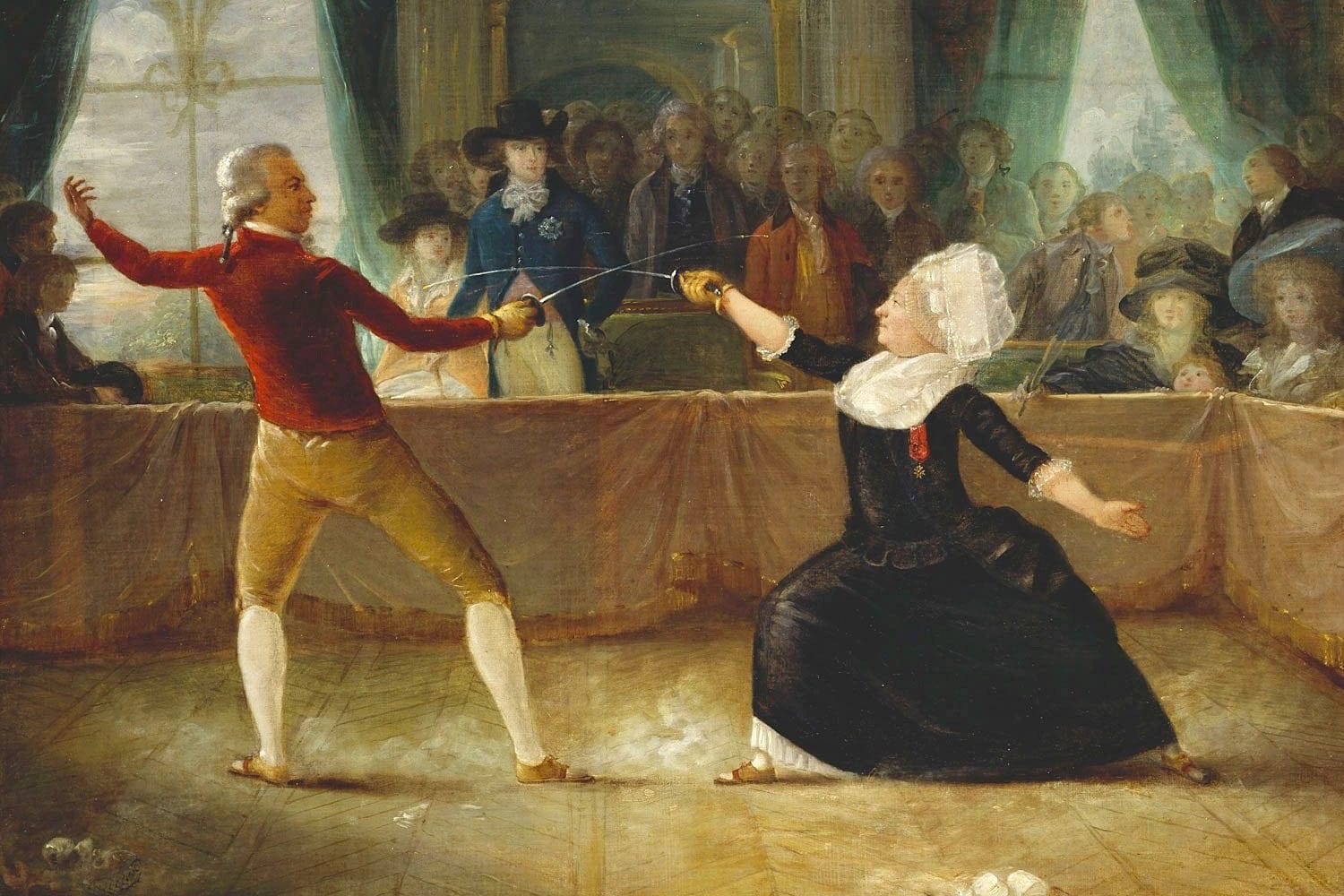
No expense was spared on the boy’s education. He excelled in music and sport, particularly fencing. At 13, he began studying with fencing master Nicolas Texier de la Boëssière, soon besting the top swordsmen around the country and across Europe. Although little is known of his musical training, he likely studied composition with François-Joseph Gossec and violin with Antonio Lolli. At 19, he was made an officer of the royal guard and dubbed Chevalier de Saint-Georges.

Fencing Match between St.-Georges and ‘La chevalière d’Éon’ by Abbé Alexandre-Auguste Robineau
In 1769, Saint-Georges was invited to join Gossec’s new elite orchestra, the Concert des Amateurs, becoming the leader of the ensemble just four years later. His star rose quickly as he became known for his virtuosic violin concertos and symphonies concertantes, a new genre combining elements of a symphony and a concerto that was especially popular in 1770s France. Symphonie concertantes typically featured two or more soloists sparring in a friendly musical battle.
In 1776, at just 30, Saint-Georges was nominated for the position of music director of the Paris Opéra. Sadly, the leading ladies of the Opéra successfully blocked the proposal by sending an appeal to Marie Antoinette in which they refused to be “subjected to the orders of a mulatto.” Undeterred, Saint-Georges presented his first opera, Ernestine, the following year at the Opéra-Comique. The music for Ernestine was met with wide acclaim, but the opera closed after a single performance due to its poorly received libretto. Fortunately, Saint-Georges soon acquired a new patron, Madame de Montesson, wife of the Duke of Orléans—the richest man in France after the king. Saint-Georges served as music director of her private theater and Lieutenant de chasse of the Duke’s hunting grounds.

Engraving of the Chevalier de Saint-Georges posing with his sword by William Ward, after the original 1787 painting by Mather Brown. Visible in the upper left-hand corner, just above his shoulder, are a page of his music and the neck of his violin.
When he was 32, Saint-Georges briefly rubbed shoulders with a 22-year-old Mozart, who had journeyed to Paris in 1778 to try to establish himself there. Mozart’s mother passed away several months into the trip, and he found himself sharing a roof with Saint-Georges after he was taken in by the Duke of Orléans’s private secretary, Baron Grimm. Although we will never know what the two composers thought of one another, scholar Gabriel Banat has suggested that Mozart was aware of his music. According to Banat, techniques used in Mozart’s Sinfonia concertante in E-flat major , written while he was in Paris, bear some resemblance to those used in Saint-Georges’s earlier Violin Concerto in A major (Op. 7, No. 1) of 1777.
Saint-Georges’s fortunes changed again as the wave of revolution began to crest around the world. In 1781, the Concert des Amateurs was dissolved due to financial losses from France’s support of the American Revolution. Four years later, the Duke of Orléans passed away, resulting in the loss of a crucial source of patronage. When revolution broke out in France in 1789, Saint-Georges sided not with his aristocratic patrons but with the revolutionaries, leading a battalion in Lille that included many people of color and foiling a counter-revolutionary plot. However, even his heroism in battle did not spare him from being imprisoned for 18 months during the Reign of Terror. Upon his release, he tried and failed to resume command of his regiment, then traveled to Saint Domingue (present-day Haiti) in 1795 as that country was in the midst of its own revolution. When he returned to Paris in 1797, he conducted only sporadically, passing away from gangrene in 1799 at just 53.
Saint-Georges narrowly escaped being erased from the historical record when his music was banned by Napoleon in the early 1800s, but he is now receiving a welcome and long overdue revival in interest. The Chevalier, a play by Bill Barclay based on Saint-Georges’s life and featuring his music, has traveled around the country and was recently performed by the London Philharmonic in March. The film Chevalier, a sumptuous biopic based on his life, premiered April 21.
And you can check out the Chicago Symphony’s rendition of the overture to his opera L’Amant anonyme (The Anonymous Lover), his only opera that survives in its entirety.